
Japanese Pickled Daikon
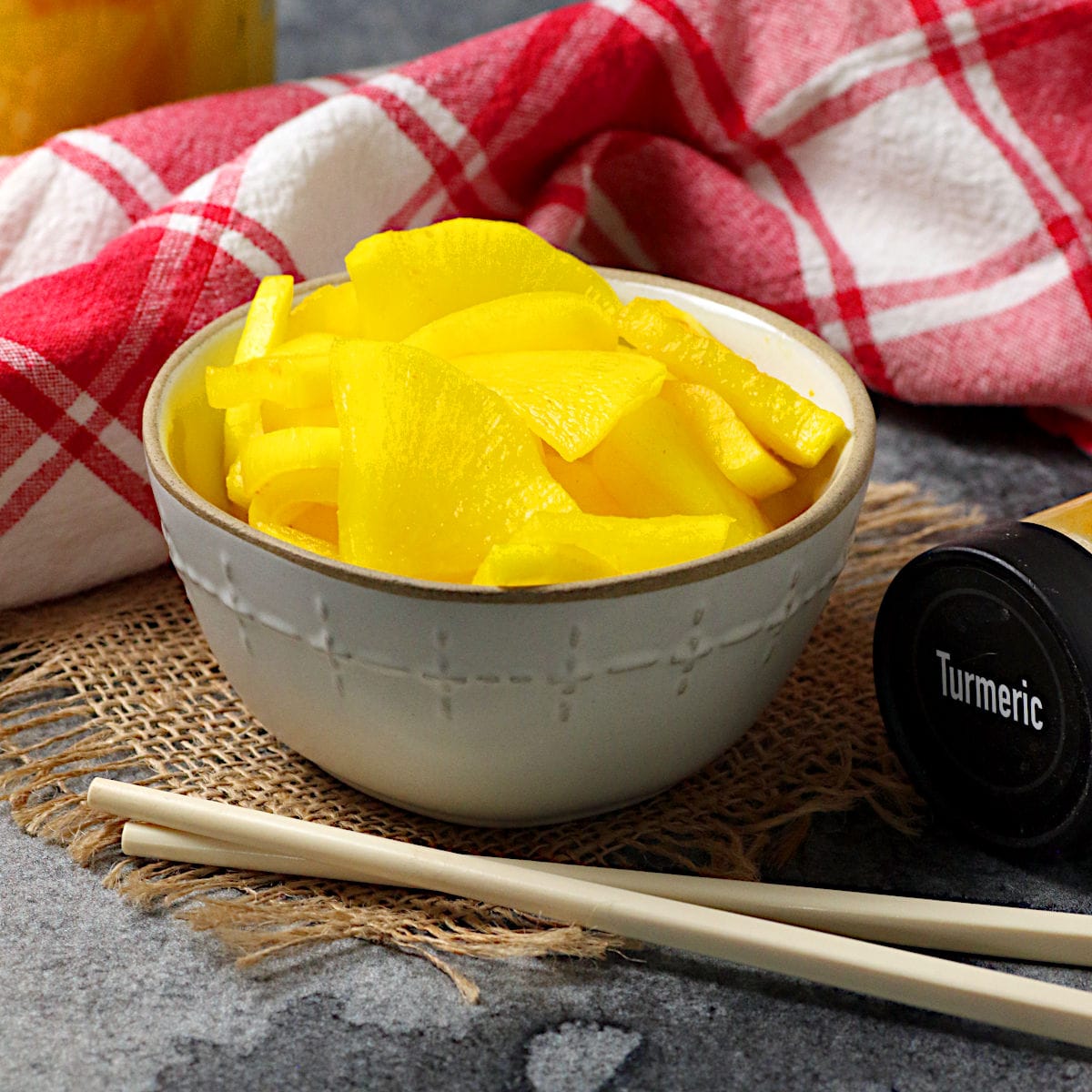
This sweet and salty Japanese Pickled Daikon is so easy to make! You need only 5 ingredients and very little hands-on time to make it.
My family loves pickles in general, but we especially love Japanese pickles (tsukemono). They can be a little hard to come by, but when we go to a Japanese restaurant that has them on the appetizer menu, we always order them.
Japanese pickles come in many varieties and can be made with various vegetables like cucumbers, eggplant, plums, ginger, and, in this case, daikon.

The bright yellow pickled daikon that is known as takuan seems to be the most common type of Japanese pickle that I’ve encountered in North America. It can be eaten alone, used to make maki, or served as an accompaniment to other dishes. It is also used in Korean dishes like kimbap.
Japanese Pickled Daikon is very crunchy, a little sweet, a little salty, and a little sour. And since it’s made with daikon, it’s got that distinctive, funky radish flavor that daikon is known for.
These pickles must come with a warning, though: if you’re sensitive to smells, you might want to avoid them. Daikon has a potent sulfury smell, so when you make these pickles, your kitchen (and maybe even your whole house) will smell like farts every time you crack open the jar.

How to Make Japanese Pickled Daikon
Making these crunchy, bright yellow pickles is incredibly easy. The majority of the hands-on work required involves prepping the daikon. Start by peeling the daikon. Cut it in half lengthwise. If your daikon is very big, you might have to cut those halves in half again (you will end up with wedges in this case). Slice the halve (or quarters) about 1/4 inch thick (about 1/2 cm).
Place the sliced daikon into a medium bowl or colander and toss the slices with kosher salt. Let the daikon sit uncovered, at room temperature, for about 3 hours.
Drain any liquid that’s accumulated, and rinse the daikon. Drain all excess water. Pack the daikon into a large jar or airtight container.
Stir the rice vinegar, sugar, and turmeric together in a measuring cup or small saucepan. Bring the mixture to a boil (microwave for about a minute to a minute and a half if using a measuring cup). Remove from heat and let the vinegar mixture cool slightly.
Pour the vinegar mixture over the daikon so that all of the daikon is completely submerged. If it doesn’t cover all of the daikon, mix up a little more of the vinegar and sugar at a 1:1 ratio – there is no need to add more turmeric. Close the jar and refrigerate for at least 3 days before serving. The pickles will last in the fridge for several weeks.
Is my Japanese Pickled Daikon supposed to smell like that?
Daikon has a pungent odor. It smells sulfury, and frankly, like farts. It is powerful enough that when I open the jar in my kitchen, Mr. Dreamboat can smell it from upstairs within a few minutes. So yes, your pickled daikon is probably completely normal. Trust that it will not taste like it smells.
Is that small amount of brine enough to cover my daikon?
I recently re-tested this recipe to make sure I had it right. When you first slice the daikon and mix up the brine, it will certainly seem like you won’t have enough.
Short answer: Yes, it should be enough brine. Longer answer: If you don’t want to fuss with pressing the daikon down, worrying whether it stays submerged, it doesn’t hurt to add a little more.
See the note in the recipe below for more information.

Japanese Pickled Daikon Ingredients
- Daikon – There are a few different types of daikon, but the one you want is the long white version. You can find daikon in the produce department of well-stocked grocery stores and Asian markets. Try to find one that isn’t too big, or you might have to cut it into smaller pieces.
- Kosher salt – avoid using table salt here.
- Sugar – just plain old granulated sugar is all you need here
- Rice vinegar – find rice vinegar in the same aisle as all the other types of vinegar. Don’t substitute regular white vinegar here, as it’s harsher.
- Ground turmeric – this is optional and mostly used for color, but it does contribute some flavor too. If you’re not a huge fan of the flavor of turmeric, but still want some yellow color, cut the amount in half. Find ground turmeric in the spice aisle.

Want more pickle recipes?
Japanese Pickled Daikon Nutrition Notes
The sodium content in the recipe below is an estimate, as some of the salt is rinsed away after the daikon is salted. I have estimated that half of the sodium remains. I have also included all of the sugar in the nutrition calculations, though likely not all of the vinegar-sugar solution will be consumed.
These pickles are vegan, gluten-free, and dairy-free.
Equipment
Ingredients
Instructions
- Cut the peeled daikon in half lengthwise (if your daikon is very large, cut the halves in half again, to form wedges), and into ¼-inch half-moons. Toss the daikon with ¼ cup kosher salt in a bowl or colander, and let sit for 3 hours, uncovered at room temperature. Rinse the daikon with cold water and drain any excess water. Pack the salted daikon into a large jar or other airtight container.
- Combine ½ cup sugar, ½ cup rice vinegar, and ½ teaspoon turmeric together in a small saucepan and bring it to a boil. Turn off the heat and stir until the sugar is completely dissolved. Cool the vinegar mixture slightly while the daikon sits. Pour the sugar-vinegar mixture into the jar with the daikon. Note that the vinegar mixture should completely cover the daikon. If it doesn't, you may need to mix up a little more vinegar-sugar mixture, using a 1:1 ratio (there is no need to add additional turmeric).
- Refrigerate the daikon for at least 3 days before serving. It will keep in the fridge for up to a month.
Nutrition
Notes
An updated note on brine volume
I recently (June 2026) re-tested this recipe after receiving several comments that the volume of brine was not nearly enough to cover 2½ pounds of daikon. While I initially thought that the amount of brine would be too little to cover the daikon, after salting it, I was reminded that it loses a lot of water and shrinks. I poured the brine over the salted daikon, and after pressing the daikon down, it was fully submerged with room to spare. While my daikon wasn’t quite a full 2.5 pounds, I think it would have been enough to just cover 2.5 pounds.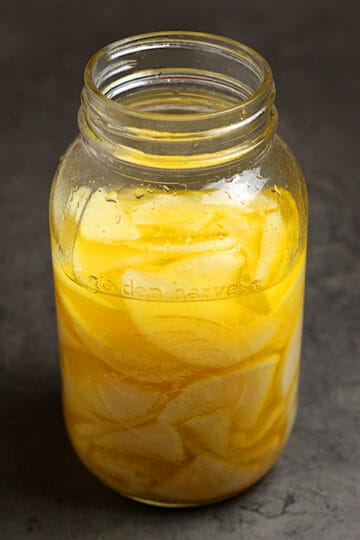
Tried this recipe?
Please Consider Leaving a Review!
This pickle turned out exactly as I have had in Ramen restaurants. I did however need to make more pickle brine and my Daikon was only 1.35lbs. If making for a 2 lb Daikon I would recommend doubling the pickling liquid.
I’m sorry, but these were soooo disgusting! They don’t taste anywhere close to the ones you get in a restaurant or at a store. After being salted for 3 hours, these still stunk up my entire kitchen. I threw them all away. I don’t recommend these!
Yes, unfortunately daikon smells bad. I mentioned this several times in my post. Fortunately, it doesn’t taste like it smells. While salting can help to reduce the smell, it doesn’t remove it completely. Some daikons might smell more strongly than others, and the compounds that cause the odor are concentrated in the outer layer of the vegetable, so aggressively peeling a thick layer of the exterior of the daikon might help.
Try this
Cut up daicon into sticks
Add 1 Tablespoon salt and mix
Let sit for 20 minutes
Rince thoroughly
Put cut up daicon into jars then make the following mixture and pour over daikon till covered. Make more batches of the mixture if you need more to cover all of the daikon.
1 c sugar
1 c hot water
11/4 c white vinegar
Let jars sit in fridge at least 24 hours. Best left a couple days.
These are addicting. There is no reason to put salt in the mixture. Love this sweet vinaigrette soaked daicon.
That amount of liquid will never cover 2.5 lb of daikon
It really depends how tightly you pack the daikon into the jar. I pack mine very tightly, which leaves little space for brine. However, if your jar is larger and/or you’re having a hard time packing the daikon in, you will need more brine. Double the vinegar and sugar (or follow a 1:1 ratio in any amount). You don’t need to add additional turmeric. I will re-test this recipe to see if the amounts need adjusting, and update the recipe accordingly.
For 2.5 lbs of radish I needed about 1 1/3 cups each sugar and vinegar.
The fact that you discovered the ratio wasn’t correct but didn’t change the ratio on the recipe is extremely disappointing. Perhaps you can find time to adjust the recipe, as the readers suggested. Your future readers will appreciate it.
I think you might have been confused about my re-testing story (it was a little wordy and I clarified it in my notes). The retesting that I did showed that the amount of brine listed in the recipe was enough to cover just over 2lbs of daikon with room to spare (see photo in the recipe notes). Even the 2.5lbs of daikon listed in the recipe should be covered completely by the brine amount listed in the recipe, if the daikon is pressed into the jar. However, if you don’t want to or are unable to press the daikon down, simply make more brine.
This is my favorite pickled daikon recipe after trying quite a few. The daikon stays crisp and is at the right tanginess. Give it a try, I highly recommend it.